
There is no single price for app maintenance in Singapore, because the bill depends on what the app does, where it runs and who looks after it. What you can control is the arrangement. For most SMEs, the lowest-risk route is a written scope that separates routine care (fixes, updates, monitoring) from new features, with the choice of provider based on what your app really needs. This guide compares the main options and shows how to get a quote you can actually compare.
TL;DR
- Maintenance is a running cost, not a one-off. Ask for it to be quoted before the build starts, not after launch.
- Routine care (bug fixes, security updates, monitoring) and new features should be quoted separately, so you can see what you are paying for.
- Your four realistic options are an in-house person, a freelancer, an agency retainer, or a ready-made product with a plan. Simpler apps usually suit the last two best.
- Whoever maintains the app, you should own the code, the hosting accounts and the credentials.
- We offer a free app fit review that shows the simplest suitable route and early cost direction before any development.
Table of Contents
- What you are paying for when you maintain an app
- What affects the cost
- A sense of scale: what large systems cost to run
- The four options compared
- How to compare maintenance quotes
- Ways to keep the cost down
- Perspective: what we tell SMEs about maintenance
- Work with us on a clear maintenance plan
- FAQ
- Sources
What you are paying for when you maintain an app
Maintenance is everything that keeps an app working and safe after launch. According to Levelworks, it covers bug fixing, security and dependency updates, operating system and browser compatibility, production monitoring, performance work, infrastructure care, testing changes and keeping operational documentation current. That last item is easy to overlook. The same guide argues that maintenance is also what keeps a system safe to change later, not only what fixes defects.
The Gig Compass adds the points that matter for mobile apps: store requirements, library updates, backend and server care, and small improvements.
For a Singapore SME, it helps to sort the work into four buckets:
- Keeping it running. Hosting, server care, monitoring, backups.
- Keeping it safe. Security patches, certificate renewals, access reviews.
- Keeping it compatible. New phone and browser versions, changes in third-party services your app connects to.
- Keeping it useful. Small tweaks and new features as your process changes.
The first three are predictable. The fourth is where budgets drift, which is why it should be agreed separately.
What affects the cost
We do not publish a fixed maintenance price, and we would be wary of anyone quoting one without seeing your app. These are the factors that move the figure.
Size and type of the app
A web app that handles bookings or attendance for one team is far cheaper to look after than a customer-facing mobile app on iOS and Android with payments and user accounts. Every platform you support is another set of updates to test.
Integrations
Each connection to another service (payments, accounting, messaging, e-invoicing) is a dependency that can change without notice. If your app touches InvoiceNow or similar systems, read our note on what Singapore SMEs should check first with InvoiceNow before you scope the work.
Hosting and infrastructure
Cloud hosting, databases and storage are usually billed by the hosting provider, not by the developer. Ask whether hosting is included in the maintenance fee or billed to your own account. The second is cleaner, as discussed below.
Security and data handling
If your app holds customer or staff data, security updates and access reviews are not optional. Our practical security guide for Singapore SME apps lists the checks worth building into any plan.
Third-party and store charges
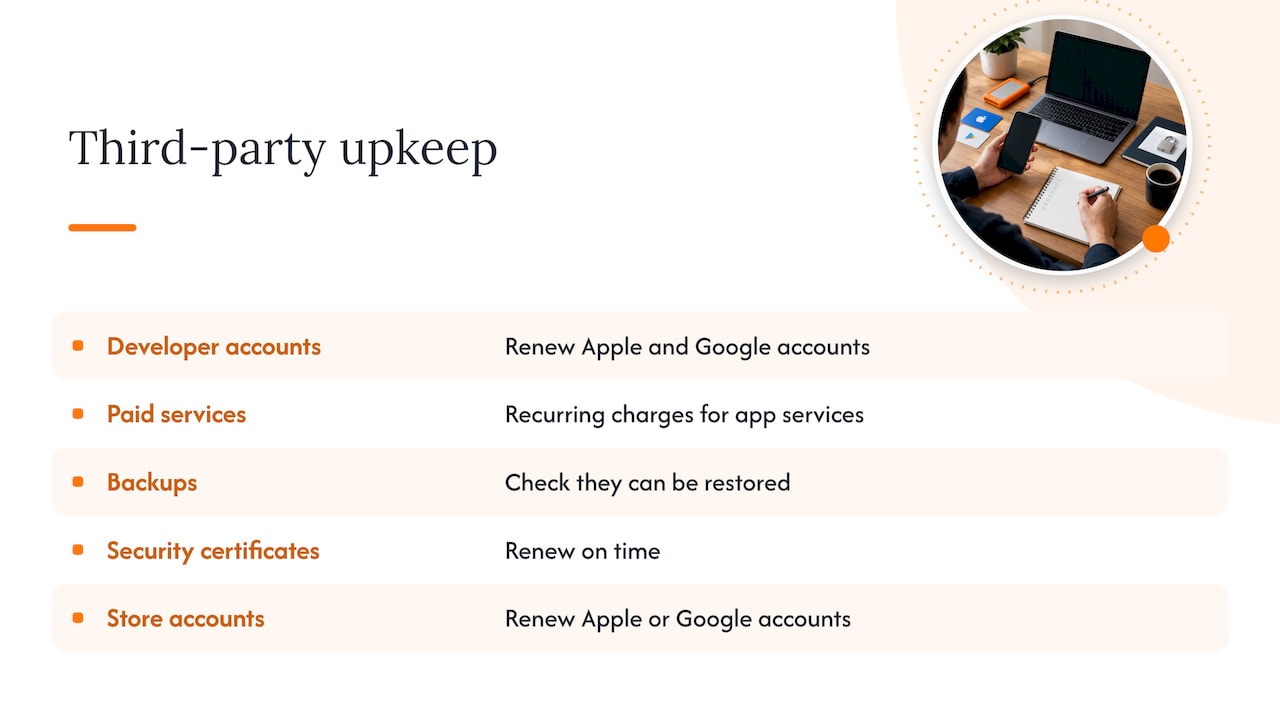
Mobile apps carry recurring charges that have nothing to do with your developer: developer account renewals with Apple and Google, and any paid software services the app calls. UX Continuum advises checking that backups can actually be restored and that security certificates and Apple or Google accounts are renewed on time. Check the current fees on Apple’s and Google’s own developer pages, as they can change.
Response expectations
A plan that promises a fix within hours costs more than one with next-working-day response. Grocito recommends defining response expectations in writing before launch, including what counts as a bug and what counts as a new request. This one clause prevents most disputes.
A sense of scale: what large systems cost to run
Public figures show how much running costs can add up for big platforms. Singapore’s Ministry of Health reported that HealthHub’s annual operating cost was about $18 million, including shared infrastructure, with three cluster-specific apps adding about $3.6 million a year. That is a national platform serving millions, not an SME benchmark. The useful lesson is that running costs are real and recurring, and that shared infrastructure is a large part of them. A small internal tool sits at a very different end of the scale, and the right question is what your app needs, not what a headline number suggests.
You will also see online guides that quote maintenance as a yearly percentage of the original build cost. Treat that as a rough starting point for a conversation only. It ignores how simple or complex the app is, and it tells you nothing about what is included.
The four options compared
| Option | Best for | What you get | What to watch |
|---|---|---|---|
| In-house person | Larger teams with several apps | Fast response, deep knowledge of your business | Salary and cover when they are away; knowledge leaves if they do |
| Freelancer | Small, stable apps with light changes | Flexible, often lower overhead | One person is a single point of failure; agree handover notes |
| Agency retainer | Custom apps with integrations and users | A team, defined response times, regular updates | Scope creep; be clear on what is routine and what is billed separately |
| Ready-made product with a plan | Common workflows such as POS, queues, events, leads, attendance | Maintenance built into the plan; updates shared across users | Fit: it must match your process closely, or be adapted first |
The table shows no prices on purpose. Prices depend on your scope, and a quote should be requested in writing from each option you consider.
In-house
Sensible when software is central to how you earn money. For most SMEs with one or two operational tools, a full-time hire is more than the work needs.
Freelancer
A good fit for a small app that rarely changes. The risk is continuity. Ask that code, documentation and accounts sit with you, not on a personal laptop.
Agency retainer
Suits custom builds where several things can break at once. Brightscout suggests that support contracts should distinguish maintenance tasks such as bug fixes, patches and monitoring from new feature projects, which are scoped and quoted separately. We agree, and it is how we would want you to compare any two quotes.
Ready-made product with a plan
If your need is common, the simplest suitable solution is often a product that already exists. Maintenance is then part of a recurring plan, rather than a separate project. Our range includes POSFlow, QueueFlow, EventFlow, PriceFlow, LeadsFlow and PresenceFlow. When a product is close but not exact, we adapt it, which is usually cheaper to run than a build from scratch.
A related comparison is low-code tooling versus a custom build. Our piece on Retool versus a custom app explains how that choice changes what you maintain.
How to compare maintenance quotes
Two quotes with the same monthly figure can cover very different things. Ask each provider the same questions.
- What is included as routine? Bug fixes, security patches, compatibility updates, monitoring, backups.
- What is billed separately? New features, redesigns, extra user training, major version migrations.
- What is the response time? For a fault that stops work, and for a minor issue. Get it in writing.
- Who pays for hosting and third-party services? Ideally accounts sit in your company’s name.
- Who owns the code and credentials? Brightscout notes it is crucial that the company keeps ownership of its code, infrastructure accounts and credentials, whoever manages the maintenance.
- Is there a handover plan? If you change provider, documentation and access should move with you.
- How are restores tested? A backup nobody has restored is only a hope.
We also have a longer guide on software maintenance planning for teams if you want a planning template.
Ways to keep the cost down
- Choose the simplest suitable solution. Fewer features and integrations means less to maintain.
- Use an existing product where it fits. Shared updates spread the cost of keeping it current.
- Keep scope clear. Use a short change request for anything beyond routine care, so nothing is billed by surprise.
- Own your accounts. Domain, hosting, app store and code repository in your name. Switching provider is then a handover, not a rescue.
- Plan features in batches. Grouping small changes into a quarterly list is usually easier to quote than ad hoc requests.
- Check grant eligibility early. If you plan to apply for support, read our note on the PSG eligibility checks to pass before payment, because timing can affect what is claimable. Confirm current terms on the official Enterprise Singapore pages.
Perspective: what we tell SMEs about maintenance
Most owners ask us about the build price first and maintenance last. We think that order is the wrong way round. A cheap build that is expensive to keep running is not a cheap build.
That is why we start with your workflow, not with a quote. Before anyone writes code, we look at what you do each day, where it slows down, and whether a ready-made product or an adapted one would solve it. Often it does. A product you do not have to build from scratch is also a product with a clearer, lower ongoing cost.
When a custom app is the right answer, we say so, and we show you early cost direction before development, including what routine care looks like afterwards. You should never find out about running costs after you have signed.
Our free app fit review is there for that purpose. It is confidential, it avoids technical jargon, and there is no pressure to commit.
Ronald
Work with us on a clear maintenance plan
If you are comparing options, start with a conversation about the workflow, not a feature list. We review how you work, recommend a ready, adapted or custom route, and set out the likely cost direction, including what care the app needs once it is live.

See our custom web apps, internal tools and workflow automation ↗ or read about app development for Singapore SMEs ↗. If a custom build looks like the right answer, our guide to when custom software pays off shows how to judge it.
FAQ
How much does app maintenance cost in Singapore?
It depends on the app, so be wary of any single figure. The main drivers are the number of platforms, integrations, hosting, security needs and the response time you want. The best approach is to ask for a written quote that separates routine care from new features, then compare like for like.
What does app maintenance include?
Typically bug fixes, security and dependency updates, compatibility with new operating systems and browsers, monitoring, infrastructure care and up-to-date documentation, as Levelworks describes. New features are normally a separate project. Confirm the exact list in your contract.
Should new features be part of a maintenance contract?
It is clearer to keep them apart. Maintenance covers keeping the app working and safe, while features are scoped and quoted on their own, as Brightscout advises. That way you can plan both budgets and see what each delivers.
Who should own the code and hosting accounts?
You should. Keep the code, infrastructure accounts and credentials in your company’s name, whoever does the maintenance. It protects you if you change provider and keeps costs transparent.
Sources
- Ministry of Health Singapore: Annual cost to maintain various healthcare apps
- Levelworks: What is application maintenance?
- The Gig Compass: App maintenance after launch
- UX Continuum: Application maintenance, what it covers and costs
- Brightscout: App maintenance and support after launch
- Grocito: Software maintenance and support after launch