
A lead tracking process is a fixed route every enquiry follows: it is captured in one place, given one owner, moved through agreed stages and closed with a recorded outcome. For a small team in Singapore, the process matters more than the software. A short list of stages, a few required fields and a named person for every lead will beat a complicated system that nobody updates. If you want that route built around how your team already works, LeadsFlow is our lead management product, built so that every enquiry has an owner and a next move.
TL;DR
- Track every lead through one pipeline with five or six stages, and write down what moves a lead from one stage to the next.
- Record only what you need to decide the next action: who they are, where they came from, who owns them and what happens next.
- Give each lead one owner and a first-response deadline. Most lost leads are not lost to competitors but to silence.
- Measure time spent in each stage, not just the final conversion rate. That is how you find the bottleneck.
- Under Singapore’s PDPA, tell people why you collect their details and get clear consent before you send marketing messages.
Table of Contents
- What a lead tracking process actually covers
- The lead tracking process, step by step
- Who does what: ownership across the process
- Metrics that show where leads get stuck
- Recording lead data under Singapore’s PDPA
- A worked example
- Choosing how to run the process
- How we help
- Our perspective
- FAQ
- Sources
What a lead tracking process actually covers
Lead tracking is the discipline of recording what happens to each potential customer from the first contact to a won or lost deal. Lead management is the wider term. It adds the work around tracking: capturing, qualifying, assigning and nurturing.
In practice, a good process should let anyone on your team answer five questions without asking around:
- Who is this lead?
- Where did they come from?
- What have we done so far?
- Who owns the next move?
- Did it turn into revenue?
If any of those answers lives in someone’s head, a WhatsApp thread or a personal spreadsheet, the process has a gap. That is where leads go missing, especially when the owner is on leave or a salesperson leaves.
The lead tracking process, step by step
The sequence below suits an SME with a small sales or customer-facing team. Each step says what it takes and where it usually goes wrong.
Step 1: Capture every enquiry in one place
List every way a lead can reach you: website form, phone call, WhatsApp message, email, walk-in, event sign-up, referral. Then decide where each one is recorded.
What it takes: one shared record, not one per person. Web forms should write straight into it. Calls and chats need a quick manual entry, ideally within the same day.
Where it goes wrong: the channels you did not list. A WhatsApp enquiry that stays on one person’s phone is invisible to everyone else. If WhatsApp is a main channel for you, map the workflow before connecting it to anything, as we explain in our guide to WhatsApp Business integration for SMEs.
Step 2: Record the minimum fields
Collect what you need to decide the next action, and add more later. Long forms put prospects off and long internal records go stale.
| Field | Why it earns its place |
|---|---|
| Name and company | Lets you recognise repeat enquiries and avoid duplicates |
| Phone or email | The way you will actually follow up |
| Source | Shows which channels produce real business, not just enquiries |
| Product or service of interest | Decides who should handle the lead |
| Owner | One named person accountable for the next move |
| Stage | Where the lead stands today |
| Next action and due date | Stops leads sitting with no plan |
| Estimated value (S$) | Helps you prioritise when time is short |
| Outcome and reason | Won or lost, and why, so you learn from both |
Where it goes wrong: asking for twenty fields at the start. Collect each extra detail only when a decision needs it, for example the budget when you prepare a quotation.
Step 3: Qualify the lead
Qualification answers a simple question: is this person likely to buy what we sell, and can we serve them? Write down two or three criteria that fit your business, such as service area, minimum order size, timing or decision-maker involvement.
What it takes: a short, written checklist the whole team uses. A call of five minutes is often enough.
Where it goes wrong: qualifying by gut feel. Two people will judge the same lead differently, and your conversion numbers will tell you nothing. Record the result as a stage change with a reason, so unqualified leads are archived rather than deleted.
Step 4: Assign one owner and a response deadline
Every lead gets one accountable person and a time by which they must make first contact. Decide the rule in advance: by product, by territory, by who is on duty, or by rotation.
What it takes: a rule that is written down and an assignment time stamp, so you can see how long a lead waited before anyone touched it.
Where it goes wrong: shared ownership. When a lead belongs to the whole team, it belongs to nobody. A simple rotation is not always fair either, because it ignores workload, skills and who is on leave. Add an escalation rule for leads untouched past the deadline, for instance a reminder to the manager.
Step 5: Move leads through clear stages
Use one pipeline. For most SMEs, five or six stages are enough:
- New lead
- Contacted
- Qualified
- Quote or proposal sent
- Negotiation
- Won or lost
For each stage, write three things: what must be true for a lead to enter it, what happens in it, and what triggers the move out. A stage such as “Quote sent” should mean a quote has actually gone out, which you can verify, not that someone intends to send one. We cover this idea in more depth in making sales pipeline stages verifiable.
Where it goes wrong: stages that overlap or mean different things to different people, and separate pipelines for every product line before you have the volume to justify them.
Step 6: Follow up on a schedule
Most deals need more than one contact. Set the next action every time you touch a lead, with a date. Reusable message templates save time, and a reminder for any lead that sits too long in a stage keeps the pipeline moving.
What it takes: the next action recorded at the end of every interaction. If a lead has no next action and no “waiting” status, it is stalled.
Where it goes wrong: follow-up that depends on memory. Routine emails are a good candidate for automation once the stages are stable. Our practical guide to email automation for operations shows where to start.
Step 7: Close the lead and record why
Every lead ends as won, lost or parked. Capture the reason in a short list of options (price, timing, chose another provider, no response, not a fit) rather than free text, so you can count them later.
Where it goes wrong: leaving dead leads open. They inflate your pipeline and hide the real picture. Closed-lost reasons are some of the most useful data you will collect.
Who does what: ownership across the process
A process fails at the handoffs. Write a small responsibility map, even for a team of three.
| Stage | Owner | Done when |
|---|---|---|
| Capture | Whoever receives the enquiry | The lead is recorded with source and contact details |
| Qualify | Sales or the business owner | Criteria checked and stage updated |
| Assign | Manager or the rule | One owner and a deadline are set |
| Follow up | Assigned owner | Next action is recorded after every contact |
| Close | Assigned owner | Outcome and reason are recorded |
If marketing and sales are separate people in your company, agree how quickly a new enquiry will be picked up. That agreement matters more than the tool you use.
Metrics that show where leads get stuck
A single conversion rate hides the problem. These measures point to the stage that needs fixing:
- Capture-to-assignment time: how long a lead waits before it has an owner.
- Assignment-to-first-contact time: how long the owner takes to reach out. Keep this separate from the first measure, because the fixes differ: one is a routing problem, the other a workload or discipline problem.
- Time in stage: a rising average in one stage is the clearest sign of a bottleneck.
- Stage-to-stage conversion: where leads drop out.
- Conversion and lead count by source: which channels bring business and which bring only enquiries.
- Closed-lost reasons: patterns in why you lose deals.
Segment these by source, product and owner. A slow stage that affects one salesperson points to workload or training. A slow stage across everyone points to your process or the lead quality.
For source tracking, tag your campaign links consistently and keep that tag on the lead record all the way to the outcome. Then, once a month, compare revenue by source with what you spent on each channel.
Recording lead data under Singapore’s PDPA
A lead record holds personal data, so Singapore’s Personal Data Protection Act applies. The practical points for an SME:
- Consent or a legal basis. An organisation must not collect, use or disclose personal data unless the person consents or the law allows it. The rule sits in the Personal Data Protection Act 2012, and consent can be withdrawn on reasonable notice.
- Tell people why. Notify individuals of the purposes on or before collection, and again if you plan a new purpose later. A short line on your web form and a clear data protection policy cover most cases.
- Be stricter with marketing messages. The PDPC’s advisory guidelines on key concepts say deemed consent by notification does not apply to direct-marketing messages, and that you should generally obtain express opt-in consent. A pre-ticked box or silence is not enough.
- Make withdrawal easy. The PDPC’s guidance on electronic direct marketing says to give a clear notice, allow people to withdraw consent, and not to treat a failure to opt out as consent in every situation.
Build these into the process itself: a consent field on the record, a source for the consent, and a way to mark someone as opted out. For specific cases, such as bought lists or messaging through chat apps, check the PDPC’s guidance or speak to a qualified adviser.
A worked example
Take a cleaning company with four staff, receiving enquiries from its website, phone and WhatsApp. Before, each person kept their own notes. A website enquiry on Friday evening was seen on Monday, and nobody knew whether someone had replied.
After setting up the process above:
- All three channels write to one list, with the source recorded.
- The manager on duty owns every new lead until it is assigned, and assignment follows the service type.
- Every lead has a first-response deadline and a next action with a date.
- Stages are New, Contacted, Site visit booked, Quote sent, Won or Lost.
- Once a week, the owner looks at leads that have sat in a stage longer than usual.
Nothing here needs advanced technology. It needs agreement on the rules and one place where they are applied. That is the real work, and it is the same whether you use a spreadsheet, an off-the-shelf CRM or a purpose-built app.
Choosing how to run the process
There are three routes: a ready-made product, an adapted product, or a custom build. Which one is right depends on how unusual your workflow is, not on how big your company is.
- If your process is fairly standard (capture, assign, follow up, close), a ready-made product is usually the simplest suitable solution and the lowest entry cost.
- If you have one or two quirks, such as a site visit stage, a specific approval step or a particular way of routing by service, an adapted product fits better than forcing your team to change habits.
- If your workflow is unusual enough that no product matches, a custom build makes sense, with a clear scope and agreed cost before development starts.
We compare the trade-offs in custom CRM versus off the shelf and in our piece on getting a small business CRM live in 4 to 12 weeks. The principle in both is the same: map the workflow first, then choose the tool.
How we help
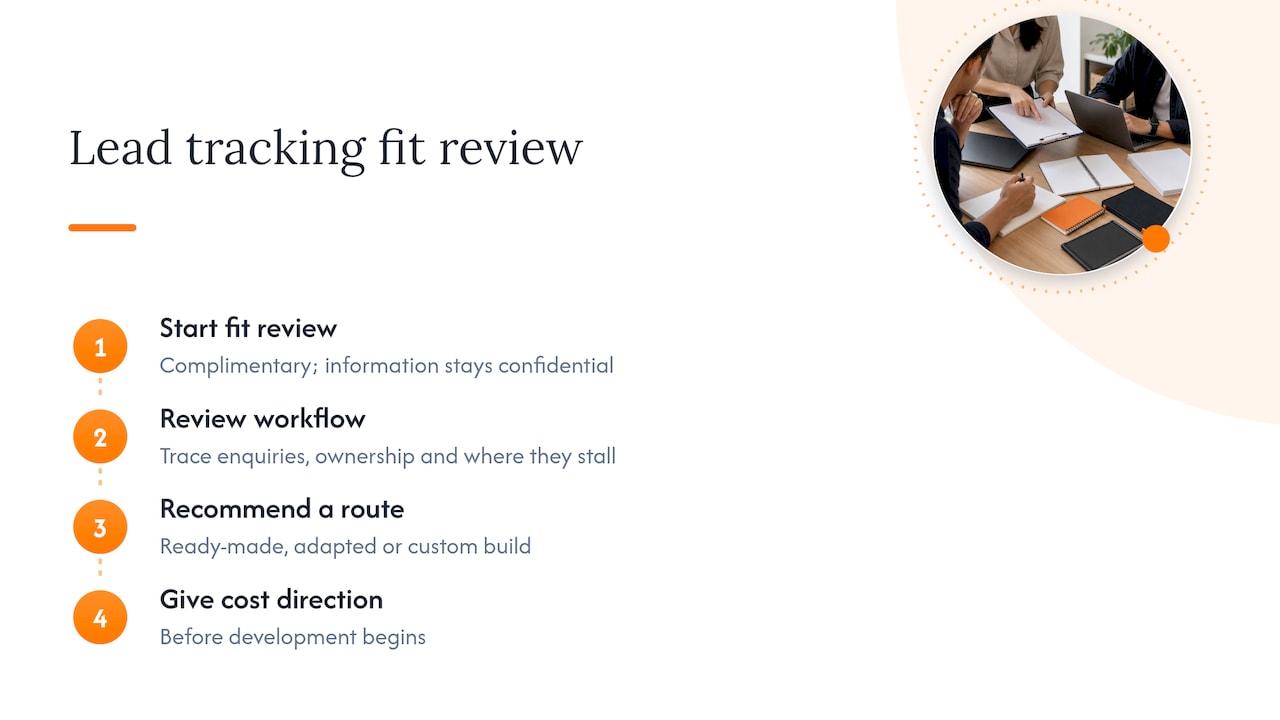
FlowLab is a Singapore app development company that works with SMEs. For lead tracking, we start with a workflow review: how enquiries arrive, who handles them and where they stall. We then recommend the simplest suitable route, a ready-made product, an adapted one or a custom build, and give early cost direction before any development begins. Our complimentary app fit review is how that conversation starts, and your information stays confidential.
LeadsFlow is our lead management product for SMEs, designed so every enquiry has an owner and a next move. You can try the LeadsFlow demo to see the flow for yourself, or browse all FlowLab products and services ↗ if your needs go beyond lead tracking.
Our perspective
Most SME owners who contact us believe they need a new system. Usually they need an answer to a simpler question: what should happen to an enquiry in the first hour, the first day and the first week?
When we review a workflow, we look for the same things each time: leads arriving through channels that nobody records, no single owner, and stages that mean different things to different people. Fix those and half the pain goes away, whatever tool sits underneath.
That is why we start with the workflow and not the software. If a ready-made product such as LeadsFlow covers what you do, that is the most economical route, and we will say so. If it needs adapting, we scope the adaptation. We only propose a custom build when your process genuinely calls for one.
Our aim is a clear scope, a cost direction you can plan around, and no technical jargon along the way.
Ronald
FAQ
What is the difference between lead tracking and lead management?
Lead tracking records what happens to each lead: contacts, stage changes, owner and outcome. Lead management is the wider process that includes capturing, qualifying, assigning and nurturing leads. In a small business the two are usually run as one workflow, with tracking as the record that holds it together.
How many stages should a lead pipeline have?
Five or six is enough for most SMEs, for example New lead, Contacted, Qualified, Quote sent, Negotiation and Won or Lost. Add a stage only when it changes who acts or what happens next. Write down what must be true for a lead to enter and leave each one.
What information should I record for each lead?
Record the contact details, company, source, product of interest, owner, stage, next action with a due date, and estimated value. Add the outcome and a reason when the lead closes. Gather anything beyond this only when a decision needs it, such as budget at the quotation stage.
Do I need consent to store a lead’s details in Singapore?
Under the PDPA you need consent or a legal basis to collect, use or disclose personal data, and you must tell people the purposes. For direct-marketing messages, the PDPC generally expects clear opt-in consent. Record the consent and its source on the lead.
How fast should I respond to a new lead?
Set a deadline you can keep and apply it to every lead, then track how often you meet it. Measure the wait before assignment and the wait before first contact separately, because each has a different fix. Faster is generally better, since prospects often enquire with several providers at once.
Sources
- Personal Data Protection Act 2012, Singapore Statutes Online
- PDPC Advisory Guidelines on Key Concepts in the PDPA, 17 May 2022
- PDPC guidance on electronic direct marketing obligations