
Most software projects move through seven phases: planning, analysis, design, coding, testing, deployment and maintenance. Some guides merge or rename them, and Agile teams repeat them in short cycles, but the logic is the same. As the person commissioning the work, you make a decision or receive a deliverable at every phase. This guide shows what those are, so you can judge progress without reading code.
We write this from the SME side of the table. At FlowLab we build and adapt business apps for Singapore companies, and the projects that go well are the ones where the owner knew what to expect at each step.
TL;DR
- The standard sequence is seven phases: planning, analysis, design, coding, testing, deployment and maintenance. Counts of six or eight come from merging or splitting these.
- Each phase should leave you with something you can read or try: a plan, a requirements document, a design, a working prototype, a test result, a live system, a support arrangement.
- Agile does not remove the phases. It runs them in short cycles, typically two to four weeks, so you see working software earlier.
- For an SME, the cheapest phase to get right is the first. A clear picture of the workflow often shows that a ready-made or adapted product is enough.
- Maintenance is a phase, not an afterthought. Agree who looks after the app before it goes live.
Table of Contents
- The seven phases at a glance
- The seven phases, one by one
- Why some guides say five, six or eight phases
- Agile: the same phases in shorter loops
- What to expect at each phase: a client checklist
- How to use the phases before you commission anything
- Start with a free app fit review
- FAQ
- Sources
The seven phases at a glance
IBM’s guide to the software development life cycle lists seven phases and the deliverable each one produces. The table below uses that sequence, with what it means for you as the client.
| Phase | What happens | What you should receive | Your decision |
|---|---|---|---|
| 1. Planning | Scope, goals and requirements are identified | An initial project plan | Is the problem worth solving, and what is the budget range? |
| 2. Analysis | Requirements are gathered and reviewed | Detailed requirements documentation | Do these requirements describe how we really work? |
| 3. Design | The architecture and screens are defined | A software design document | Does the design match the workflow? |
| 4. Coding | The first code is written | A functional prototype | Is this the right direction? |
| 5. Testing | Code is reviewed and bugs are removed | Refined, tested software | Is it ready for real users? |
| 6. Deployment | The software goes into production | Software available to end users | When do we switch over? |
| 7. Maintenance | Continual fixes and improvements | Updated, optimised code | Who supports it, and how often do we review it? |
The rest of this guide walks through each phase in plain terms.
The seven phases, one by one
Phase 1: Planning
Planning sets the scope, the goals and the rough requirements. The deliverable is an initial project plan. Atlassian adds a step here that matters to anyone paying for the work: a feasibility analysis that checks whether the project is technically and financially viable, including cost estimation and risk analysis.
For an SME, this is the phase to ask three questions:
- What exact problem are we solving, and who feels it every day?
- What does the problem cost us now in time, errors or lost sales?
- Does a ready-made product already cover most of it?
The third question is the one many businesses skip. A queue that needs managing, an event that needs registration or a shop that needs a point of sale are common needs with proven foundations. Starting from one of those is usually the lowest entry route. If you are weighing the two routes, our five tests for build versus buy help you decide.
Phase 2: Analysis
Analysis turns the plan into detailed requirements. IBM describes it as gathering and reviewing data on what the project needs, with fully detailed requirement documentation as the output.
This is where you describe your day, not the software. Walk the team through how an order, a booking or a lead moves from the first message to the final payment. Show the spreadsheets, the WhatsApp threads and the paper forms. A good analyst writes down the steps, the people involved and the exceptions, then asks you to confirm them.
You do not need a technical brief. You need to be able to say: “Yes, that is how we work,” or “No, you missed what happens when a customer cancels.”
Phase 3: Design
Design defines how the system will be built: the architecture, the data it holds and the screens people will use. The deliverable is a software design document. Microsoft’s guide to the life cycle names the same seven phases, with design sitting between analysis and development.
Ask to see the screens before anything is built. Staff who will use the app daily should look at them. If a counter clerk cannot tell what to tap in ten seconds, the design needs another pass. Changing a drawing costs far less than changing finished code.
Phase 4: Coding
Coding is where the first working software appears. IBM gives the deliverable as a functional software prototype. Microsoft calls this phase development.
What you should ask for is regular, short demonstrations on a test version. Seeing a working screen in week two tells you far more than a status report. If the first time you see anything is the day it is finished, the plan carries a lot of hidden risk.
Phase 5: Testing
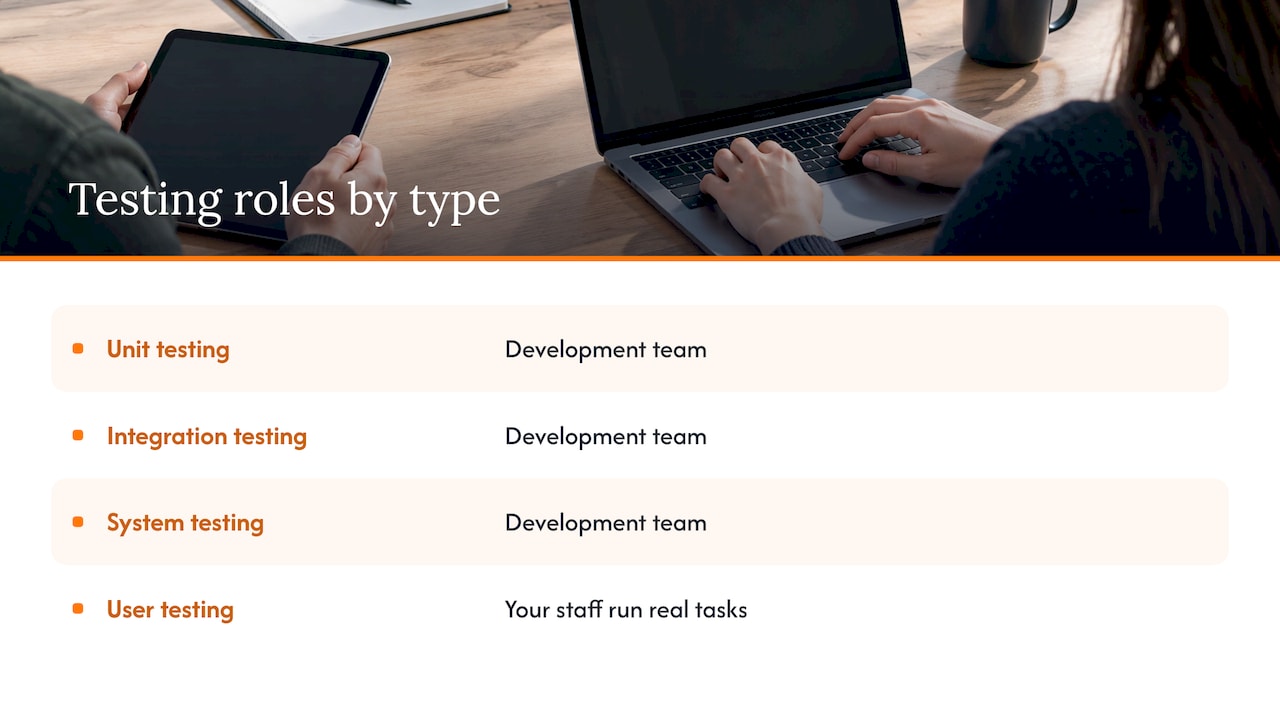
Testing reviews the code and removes bugs. Microsoft describes unit, integration, system and user testing as the usual types. The first three are the development team’s job. The last one is yours.
User acceptance testing means your own staff run real tasks on the app and confirm it does what the requirements said. Use real examples: last week’s busiest day, a refund, a customer with a double-barrelled name. Our UAT test plan template for SMEs gives you seven sections you can paste into Word or Excel.
Testing also depends on the kind of business you run. If you handle sensitive data, the Monetary Authority of Singapore expects regulated financial institutions to cover business logic, system function, security controls and performance under load in system testing, as set out in its Technology Risk Management Guidelines. Those guidelines apply to financial institutions, but the checklist is a sensible reference for any business whose app touches payments or personal data.
Phase 6: Deployment
Deployment puts the software into the production environment so end users can use it. The practical questions are about people, not servers:
- Who is trained, and when?
- Do you run the old and new way side by side for a few days?
- What is the fallback if something fails on the busiest day?
Avoid going live on a peak day. Pick a quiet period, start with one outlet, team or event, and widen from there. A short period of extra support right after go-live catches the small issues that only appear with real use. Our 10 step hypercare plan covers this in detail.
Phase 7: Maintenance
Maintenance means continual fixes and improvements. IBM lists its deliverable as updated and optimised code. Browsers update, staff change roles, and the business adds a second product line. An app that nobody looks after slowly stops fitting.
Settle three things before launch: who fixes faults, how quickly they respond, and how often you review whether the app still matches the workflow. Our guide to software maintenance planning explains how to set that up.
Why some guides say five, six or eight phases
You will see different counts. TechTarget notes that some sources argue for five or six main steps, though the general consensus is seven. Figma makes the same point: the number varies by source and model, but the core logic stays the same. Define before you design, design before you build, and test before you ship.
In practice the differences are mostly labels:
- Planning and analysis are sometimes one phase called “requirements”.
- Coding is also called development or implementation.
- Feasibility is sometimes its own phase, as in Atlassian’s list.
- Testing and deployment are sometimes merged into “release”.
When a vendor quotes you a different number, do not worry about the count. Ask what you receive and what you decide at each stage.
Agile: the same phases in shorter loops
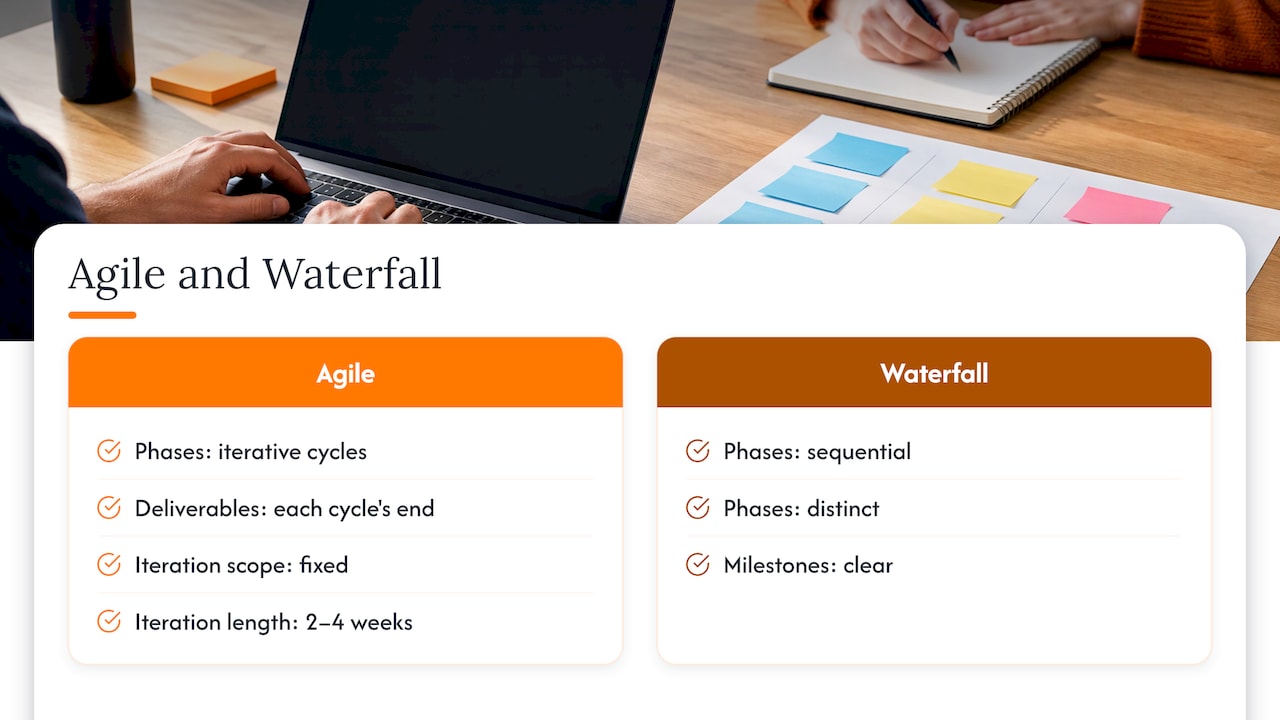
A common mix-up is to treat Agile as the opposite of phases. The UK government’s guidance describes Agile as traditional project phases taking place in iterative cycles, with deliverables produced at the end of each cycle. Waterfall, by contrast, is sequential, with distinct phases and clear milestones.
The ECSS Agile handbook says that in Agile, analysis, design, coding and testing are continuous activities, with fixed-length iterations and a fixed scope inside each one. It puts typical iteration length at two to four weeks.
Singapore’s government developers work this way. GovTech’s developer portal describes Scrum as a framework for an Agile way of working, built on transparency, inspection and adaptation. Its engineering practices page says that each increment should be shippable by the end of the sprint.
Waterfall or Agile for an SME project?
IBM lists eight common models, including Waterfall, V-model, Agile, Iterative, Spiral and Rapid Application Development, and says the right choice depends on whether requirements are clear or likely to change, and on complexity. A simple rule of thumb:
- Requirements are clear and stable (a form, a report, a fixed approval flow): a plain sequence with a fixed scope works well.
- You expect to learn as you go (a new service, a new customer journey): short cycles with a demo at the end of each.
- Mixed: fix the scope of the first release, then iterate.
The ECSS handbook notes that in waterfall models the needs of the business may have changed by the time the project finishes, which Agile handles by letting scope vary and planning adapt. That flexibility needs a guardrail, though. Without a clear scope per cycle, small additions pile up. Our scope creep management guide shows how to keep changes visible, and the article on scope creep in consulting explains how the same problem appears in client work generally.
The Unified Process: four phases, not seven
University courses sometimes teach a different split. The National University of Singapore’s software engineering book describes the Unified Process as four phases: inception, elaboration, construction and transition. Inception covers understanding the problem and planning. Elaboration refines requirements and sets the high-level design. Construction is the main build and testing. Transition prepares the system for production and familiarises users. It is the same journey with different boundaries.
What we have learned about project phases
Most SMEs that come to us do not need to learn the vocabulary of software development. They need someone to look at how work moves through their business and say what is the simplest suitable solution.
That is why we put the first phase ahead of everything else. We start with a workflow-first review. We look at where time is lost, where information is retyped and where things get forgotten. Only then do we say whether a ready-made product, an adapted product or a custom build fits.
Often the answer is the lowest entry route: a product such as POSFlow, QueueFlow or EventFlow, adapted to your process. Custom work is for the cases where no foundation fits. Either way, you should know the likely cost direction before development starts, and your information stays confidential throughout.
The phases are only useful if you can see them. At each one, you should be able to say what you received and what you are deciding next.
Ronald
What to expect at each phase: a client checklist
Use this list in your first meeting with any developer, including us.
- Planning: a written scope, a cost direction and a view on whether a ready-made option fits.
- Analysis: a requirements document in plain language that you can mark up with corrections.
- Design: screens or mock-ups reviewed by the people who will use them.
- Coding: short demonstrations on a test version, not one reveal at the end.
- Testing: a test plan that includes your real scenarios, with your staff signing off acceptance.
- Deployment: a go-live plan with training, a quiet start date and a named contact for problems.
- Maintenance: an agreed support arrangement and a scheduled review of whether the app still fits.
Two cross-cutting points sit on top of this list. First, security should be built in across all phases rather than added at the end. The MAS guidelines describe security by design as building security into every phase of the life cycle. Second, agree the commercial model early. Whether you pay a fixed price or time and materials changes how much flexibility each phase has, and our five questions on fixed price versus time and materials will help you choose.
How to use the phases before you commission anything
You can use the phases as a preparation tool. Before approaching a developer, spend an afternoon on the planning and analysis steps yourself:
- Write down the three tasks that cost your team the most time each week.
- For each, note who starts it, who finishes it and where the information lives.
- Mark the points where mistakes happen: double entry, missed follow-ups, unclear status.
- Note which tasks are common ones such as sales, queues, event sign-ups, lead tracking or attendance.
This gives any developer a head start and lets you compare proposals on equal terms. If you want to compare tools on a short trial, our guide to finding workflow tools and proving return in 4 to 8 weeks gives a structure for it. If you are planning a project in Singapore and wondering about funding, the EDG app development planning page explains how we approach planning. For cost expectations, see our app development cost guide for Singapore SMEs.
Start with a free app fit review
If you are at the planning stage, we can run the first two phases with you. Our complimentary app fit review looks at your workflow, recommends the simplest suitable route, and gives you an early cost direction before any development begins. There is no technical brief to write and no pressure to commit.

We can start from a ready product such as POSFlow or QueueFlow, adapt one to your process, or build a custom web app when nothing fits. See our custom software development service for SMEs ↗ or talk to us through the main site ↗.
FAQ
What are the seven stages of software development?
They are planning, analysis, design, coding, testing, deployment and maintenance. Each has a distinct task and a deliverable, from an initial project plan through to updated code. Some guides name them slightly differently, for example feasibility, implementation or development.
Does the software development life cycle have six or seven phases?
Both counts appear, because sources merge or split the same work. The general consensus is seven, and some guides use five or six by combining steps such as planning and analysis. The order of the work is the same either way, so compare what you receive at each step rather than the number.
How is Agile different from the software development life cycle?
The life cycle describes the phases of the work. Agile is a way of organising that work. Instead of one long pass through every phase, Agile repeats them in short cycles, commonly two to four weeks, and delivers a usable increment each time.
Which phase matters most for a small business?
The first two, planning and analysis. A clear description of your workflow decides whether you need a ready-made product, an adapted one or a custom build. It also sets the scope that testing is later measured against.
Who is responsible after the software goes live?
That is settled in the maintenance phase, and it should be agreed before launch. Decide who fixes faults, how quickly they respond and when you review the app. Writing this down avoids surprises when the first change request arrives.
Sources
- What is the Software Development Lifecycle (SDLC)? | IBM
- Software Development Life Cycle | Microsoft Power Automate
- What is Software Development Life Cycle (SDLC)? | Atlassian
- The 7 stages of the SDLC explained | TechTarget
- SDLC Phases: A Guide for Product Teams | Figma
- Contracting For Agile Guidance Note | GOV.UK
- Agile software development handbook | ECSS
- Introduction to Agile Development | GovTech Developer Portal
- Engineering Practices | GovTech Developer Portal
- Technology Risk Management Guidelines | Monetary Authority of Singapore
- CS2103/T SDLC Process Models | NUS
- Scope Creep in Consulting: What Consultants Must Know