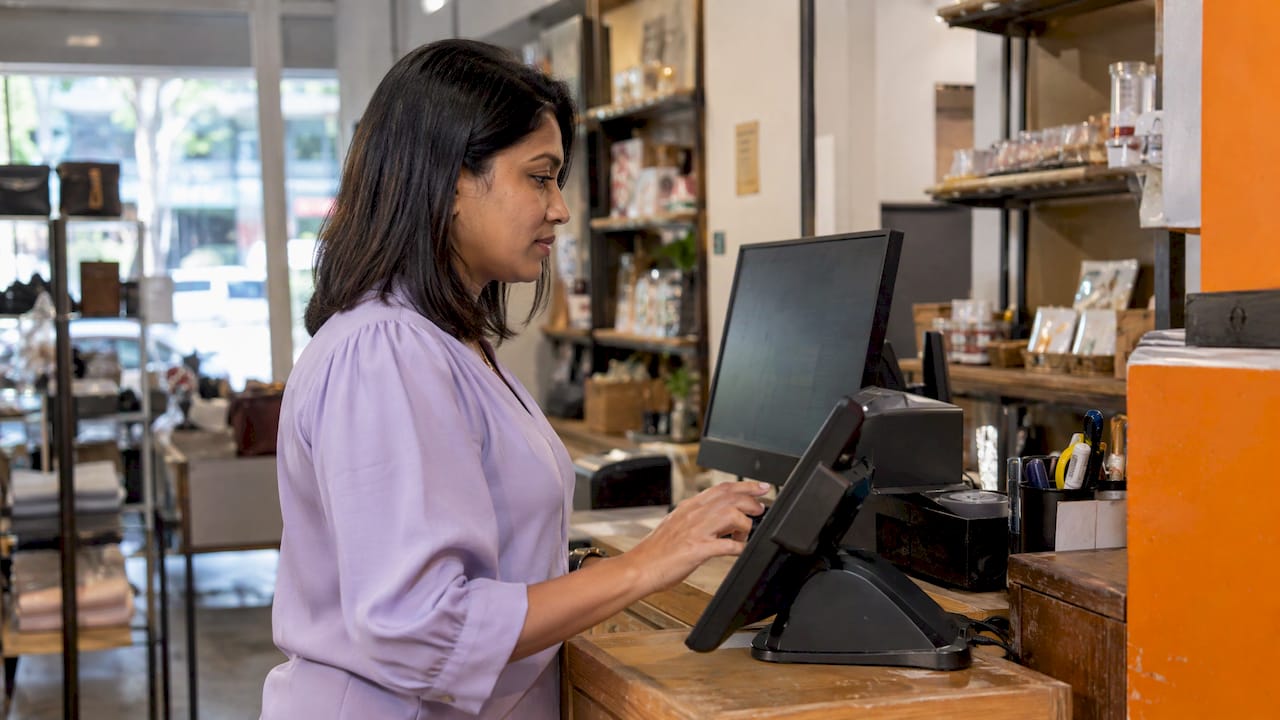
InvoiceNow integration means your invoicing software sends and receives invoices as structured data over Singapore’s Peppol-based network, and, if you are GST-registered, passes the invoice data to IRAS. For most SMEs the work is not building a new system. It is checking that the software you already use can do this, that your invoice data is complete, and that the apps feeding it (POS, orders, inventory) hand over clean records. We start with that workflow review, and we tell you the simplest suitable route before any build is discussed.
TL;DR
- InvoiceNow is Singapore’s nationwide e-invoicing network on the Peppol standard, covering business-to-business invoices only.
- For GST-registered businesses it becomes mandatory in phases. New voluntary registrants are already covered, and existing registrants follow between 1 April 2028 and 1 April 2031, depending on annual supplies.
- You connect through an InvoiceNow-Ready solution, usually your accounting or ERP software, which uses an IMDA-accredited Access Point.
- The common failures are in the data: missing mandatory fields, unmapped Peppol IDs, and sales from POS or other apps that never reach the accounting system.
- Test every invoice flow end to end before your first live GST return that relies on it.
Table of Contents
- What InvoiceNow is, in plain terms
- How the connection works: four corners
- Is InvoiceNow mandatory for your business?
- What IRAS expects you to send
- Step by step: integrating InvoiceNow with your apps
- Security and confidentiality
- Common workflow gaps we see SMEs plan for
- Where FlowLab fits
- FAQ
- Sources
What InvoiceNow is, in plain terms
InvoiceNow was introduced by IMDA (the Infocomm Media Development Authority) in 2019. It lets businesses send and receive invoices digitally, and IRAS describes it as built on the Peppol standard. Peppol is an international standard for exchanging business documents. Singapore adapted it from government procurement for ordinary business use, and IMDA acts as the national Peppol Authority that accredits providers and sets local rules.
The difference from emailing a PDF is automation. IMDA’s FAQs explain that the invoice travels as structured data from your finance system to your customer’s, without anyone retyping it, and it can allow the invoice to be paid seamlessly. It covers B2B transactions, not B2C.
IRAS’s own brochure notes that over 60,000 businesses are already on the network.
How the connection works: four corners
The network uses a four-corner model. Stripe’s guide lays it out simply:
- Corner 1: your own system creates the invoice.
- Corner 2: your Access Point (AP) converts it to the Peppol format, a UBL XML file, and sends it.
- Corner 3: your customer’s AP receives it.
- Corner 4: your customer’s system takes in the structured data.
Your business is addressed on the network by a Peppol ID tied to your UEN (Unique Entity Number). IMDA’s info sheet adds that the AP checks the recipient’s Peppol address in a directory before routing the document. For GST purposes there is a fifth step: IRAS receives a copy of the invoice data through the same AP.
You do not need to run any of this yourself. You subscribe to an InvoiceNow-Ready solution or an Access Point provider, and IMDA says you can activate InvoiceNow on any certified Peppol Ready solution listed on its website.
Is InvoiceNow mandatory for your business?
It depends on whether you are GST-registered and when you registered. Under IRAS’s e-Tax Guide on the GST InvoiceNow Requirement, the phases are:
| Who | From |
|---|---|
| Newly incorporated companies registering voluntarily within six months of incorporation | 1 November 2025 |
| All new voluntary GST registrants | 1 April 2026 |
| New compulsory registrants, and existing registrants with annual supplies up to S$200,000 | 1 April 2028 |
| Existing registrants with annual supplies up to S$1,000,000 | 1 April 2029 |
| Existing registrants with annual supplies up to S$4,000,000 | 1 April 2030 |
| Existing registrants with annual supplies above S$4,000,000 | 1 April 2031 |
IRAS notifies existing GST-registered businesses of their own implementation date, so your notice is the date that counts. If you are not GST-registered, InvoiceNow is optional, though your larger customers may ask for it.
The pattern matters more than the single date. The phases run from the newest and smallest registrants to the largest, and a business that waits until its date finds itself choosing software, cleaning data and testing at the same time. Starting a year ahead costs little and removes that squeeze.
What IRAS expects you to send
GST InvoiceNow is not just about invoices you issue. The e-Tax Guide says you must submit standard-rated, zero-rated and exempt supplies, and standard-rated and zero-rated purchases, minus excluded transactions. Invoice data is due by the earlier of the day you file the relevant GST return or its due date.
Two points catch SMEs out:
- Mandatory data elements. Invoices and credit notes must carry prescribed data fields. A missing customer UEN or GST number can hold up a submission.
- Invoices that never travel over InvoiceNow. The same guide says invoices to customers not on the network, or sales through a POS, must still be submitted to IRAS once they are recorded in the accounting system. IRAS’s onboarding guide allows POS, simplified tax invoice and petty cash transactions to be submitted in aggregated form.
On the customer side, IMDA confirms that an InvoiceNow e-invoice does not need the words “Tax Invoice” to support a GST input tax claim, provided the contents required by the GST (General) Regulations are present.
Step by step: integrating InvoiceNow with your apps
1. Map where invoices and sales are created
List every place a sale or purchase is recorded: accounting software, POS, an order form, a spreadsheet, a quotation tool, a supplier portal. InvoiceNow integration only works well if these feed one system of record. Where a step is still paper or a spreadsheet, that is the first bottleneck, and our guide to a paper-to-digital workflow covers how to tackle it.
This is the step we do first with clients. We review the workflow before recommending anything, so you see which gaps need an adapted product or a small build and which need nothing at all.
2. Check whether your accounting software is InvoiceNow-Ready
IMDA defines an InvoiceNow-Ready solution as one that supports both basic InvoiceNow and the GST InvoiceNow Requirement, and requires accredited products to prove they can submit a Peppol invoice to IRAS and handle errors such as missing mandatory data. IMDA’s April 2024 listing of Peppol-ready providers included Xero, SAP Business One, Sage 300, TallyPrime and QuickBooks with LinkFor, among others. The list changes, so confirm your product on IMDA’s current page.
Being on the list is not the same as being switched on for your account. Ask your provider whether InvoiceNow is activated on your plan, whether credit and debit notes are handled, and whether the GST InvoiceNow submission to IRAS is included.
If you use Xero, our note on Xero integration options for Singapore SMEs shows how other business apps can connect to it.
3. Get your Peppol ID and partner records in order
Your Peppol ID follows from your UEN and is registered through the AP. IMDA’s guidance says to add a Peppol ID field to business partner records and to map your system’s data to the Peppol dataset with the AP. It also advises updating purchase order documents with your Peppol ID and telling trading partners you are ready. In practice, this is a data-cleaning job: one customer record, one UEN, one correct GST status.
4. Connect the apps that feed the books
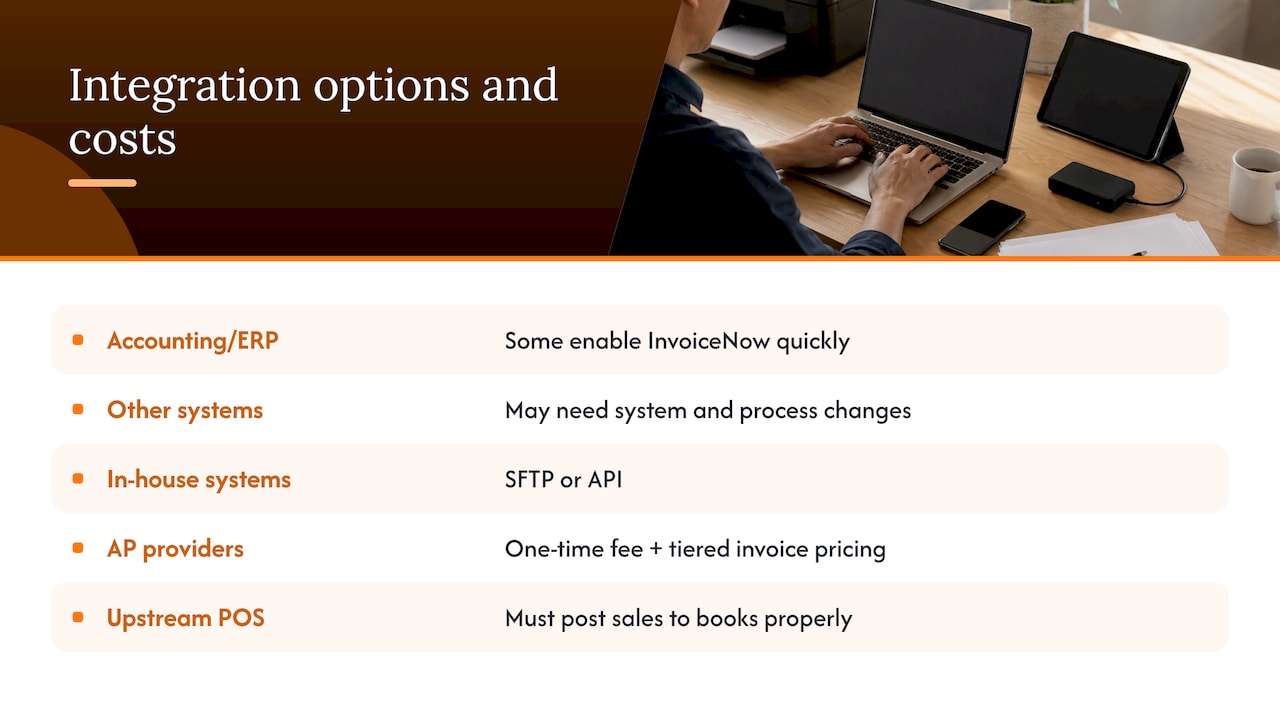
Many local accounting and ERP products can switch on InvoiceNow sending quickly, while others need system and process changes. For in-house systems IMDA’s info sheet says connections typically use SFTP or an API, and that AP providers usually charge a one-time integration fee plus tiered per-invoice pricing. Ask for both before you choose.
The weak link is usually the app upstream of the accounting software. If your POS does not post sales to the books properly, the invoice data IRAS receives will be incomplete. See our walkthrough on getting POS accounting integration working in days, and, if you are choosing a till, how to compare POS options in Singapore.
If the apps you rely on do not connect, we look at your workflow and tell you whether an adapted product or a custom build is the most economical fix. The review is free, and it clarifies likely costs before development starts.
5. Test every invoice flow before going live
IRAS’s onboarding guide directs businesses to run end-to-end tests of each invoice submission flow, clear any solution-specific technical issues and confirm support contacts with their provider before going live. Build a short test list:
- A standard-rated sales invoice to a customer on InvoiceNow
- A zero-rated or exempt sale
- A credit note
- A purchase invoice received from a supplier
- A POS day-end batch
- An invoice to a customer who is not on the network
- An invoice with an attachment
IMDA’s accreditation guide mentions handling attachments over 10MB, so include a large one.
Security and confidentiality
Owners often ask whether sending invoice data over a national network is safe. IMDA states that only Peppol-certified access points with PKI certificates are on the network, data is protected in transit with SSL, and transmissions are signed so the receiving AP can verify the sender. Inside your own business, access rules still matter: who can edit an invoice, who can approve it, and who sees customer data. Our guide to security for small business apps covers that practically.
Common workflow gaps we see SMEs plan for
| Gap | Why it matters | Practical fix |
|---|---|---|
| Sales recorded in a POS that does not post to the books | GST InvoiceNow data will be incomplete | Connect POS to accounting, or adapt a POS foundation |
| Customer UENs held in spreadsheets | Peppol IDs cannot be mapped | One clean customer record in the system of record |
| Payments received outside the invoicing system | Invoices stay unpaid on paper | Link the payment gateway to the invoice |
| Manual credit notes | Credit notes must carry mandatory data too | Issue them from the accounting system only |
If payments are part of this, our comparison of payment gateways in Singapore and of Stripe and HitPay shows how fees and POS workflow affect the invoice trail. If stock drives your invoices, see why SMEs should check InvoiceNow first when choosing inventory software.
Where FlowLab fits
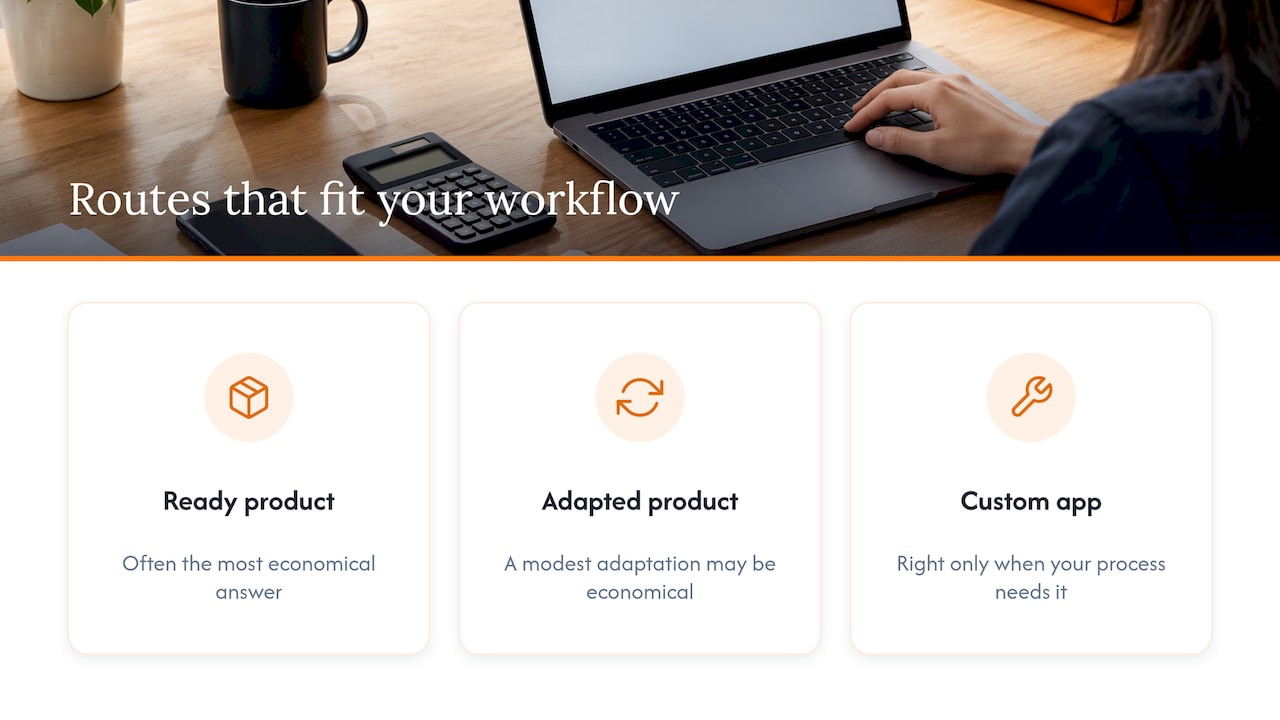
Our offer is simple. We review your workflow first, then recommend the simplest suitable route: a ready-made product, an adapted one, or a custom app. We offer POSFlow for point of sale, QueueFlow for queue management, EventFlow for event registration, PriceFlow, LeadsFlow for lead tracking and PresenceFlow for attendance, plus custom web apps, internal tools and workflow automation. Our complimentary app fit review clarifies the likely cost before development, and we keep your information confidential.
If your sales start in a till, an event desk or a lead form and need to reach your accounting records cleanly, POSFlow is a natural starting point. For anything more specific to your process, tell us about your workflow ↗ and we will say which route fits.
Our view
Most SMEs treat InvoiceNow as a software purchase. We see it as a workflow question. The network and the Access Point are standardised, so the part that differs from one business to the next is how a sale becomes a clean, complete record.
That is why we begin by understanding the operation, not by proposing a build. Often the most economical answer is a ready product or a modest adaptation of one, and a custom app is the right answer only when your process genuinely needs it. You should not need a technical brief to have that conversation.
A business that gets its records right once benefits well beyond compliance: faster reconciliation, fewer re-keyed figures, and less chasing.
Ronald
FAQ
Is InvoiceNow mandatory in Singapore?
Only for GST-registered businesses, and in phases. New voluntary registrants are already in scope, and existing registrants follow between 1 April 2028 and 1 April 2031 by annual supplies, per IRAS’s e-Tax Guide. IRAS notifies existing registrants of their date.
Do I need to replace my accounting software?
Not necessarily. IMDA says many local accounting and ERP providers can switch on InvoiceNow sending quickly, while others need changes. Check that your product is InvoiceNow-Ready and that the feature is active on your plan.
Does InvoiceNow cover invoices to consumers?
No. IMDA’s FAQs say it covers B2B transactions only. GST-registered retailers must still submit POS and simplified invoice data to IRAS, which IRAS allows in aggregated form.
What does an Access Point provider charge?
IMDA’s info sheet says providers usually charge a one-time integration fee plus tiered pricing per e-invoice, depending on volume. Prices vary by provider, so request a written quote.
Sources
- IRAS: GST InvoiceNow Requirement
- IMDA: InvoiceNow FAQs
- IMDA: InvoiceNow brochure
- Stripe: InvoiceNow in Singapore guide
- IMDA: e-invoicing info sheet
- IRAS: e-Tax Guide on the GST InvoiceNow Requirement
- IRAS: e-Tax Guide (mandatory data elements)
- IRAS: e-Tax Guide (supplies and purchases to submit)
- IRAS: GST InvoiceNow onboarding guide
- IMDA: InvoiceNow-Ready accreditation guide 2025
- IMDA: Peppol-ready provider listing, April 2024