
If you are looking at the EDG grant to help pay for business software, the first thing to know is that it has closed. The Enterprise Development Grant stopped taking new applications on 29 September 2026, and from 30 September 2026 new business grant applications go under the EDGE Grant. Software can still be supported, but the activities, caps and rules now sit under the new scheme.
This guide explains what the EDG covered, what that means for software and app projects, how eligibility and applications worked, and how to prepare so you are ready for an EDGE application.
TL;DR
- The EDG ceased on 29 September 2026. New applications now go through the EDGE Grant, via the Business Grants Portal.
- Under the EDG, qualifying costs included third-party consultancy fees, software and equipment, and internal manpower. EDGE is activity-based, so check the specific activity for your project.
- Eligibility centres on a Singapore-registered business with at least 30% local ownership and a project that has not yet started.
- Do not sign, pay a deposit or start work before you submit. Grant rules treat that as a project already begun.
- Start with the workflow problem, not the grant. The simplest suitable app is usually also the easiest to justify.
Table of Contents
- Is the EDG still available?
- What the EDG covered for software
- What EDGE changes for software and apps
- Who is eligible
- How to apply without losing the grant by mistake
- What a grant-ready software project looks like
- Our perspective: grants should follow the project
- Planning an app project with us
- Choosing a vendor when a grant is involved
- FAQ
- Sources
Is the EDG still available?
No, not for new applications. Enterprise Singapore states that the EDG, MRA and PSG ceased on 29 September 2026, and that from 30 September you apply for business grant support under the EDGE Grant. The same page says that if you already have an ongoing EDG, MRA or PSG submission or project, it continues to be processed, and you submit claims through the Business Grants Portal (BGP) when the project is complete.
So there are two groups of readers:
- You have an approved or pending EDG project. Carry on. Keep your invoices, deliverables and proof of completion in order for the claim.
- You were planning to apply. You now apply under EDGE. Much of what the EDG taught about preparing a project still applies, but you should read the EDGE activity page for your type of project before you commit to anything.
Many older pages, including consultants’ pages, still describe the EDG as open. Some also quote different support levels. Treat any page that does not mention the 29 September 2026 change as out of date.
What the EDG covered for software
The EDG funded projects that helped a business upgrade, innovate, grow and transform. Enterprise Singapore’s EDG page identified the qualifying costs as third-party consultancy fees, software and equipment, and internal manpower costs, with support of up to 50% of eligible costs for eligible local SMEs. Support was assessed against the approved project and its qualifying costs, not against a price list.
For a business buying an app or system, that meant software was one part of a wider project. A typical shape looked like this:
| Cost type | Example in a software project |
|---|---|
| Third-party consultancy | Workflow analysis, process redesign, requirements work |
| Software | The licence, subscription or development of the application itself |
| Equipment | Tablets, scanners, printers or kiosks the app depends on |
| Internal manpower | Staff time spent on the project, where the scheme allowed it |
The point most owners missed: the grant paid for a project with a business outcome, not for a piece of software on its own. A proposal that said “we want an app” was weaker than one that said “our front desk spends two hours a day re-keying registrations, and this project removes that”.
What EDGE changes for software and apps
EDGE replaces the separate schemes with one activity-based grant. In practice, you pick the activity that matches your project and then meet that activity’s conditions. Three details from Enterprise Singapore’s EDGE pages matter for software buyers.
Software costs are time-limited. For approved activities such as integrated ERP and accounting solutions, software costs are supported, capped at 12 months. If you are buying a subscription, ask what a 12-month window means for your contract.
Vendor status affects speed. For Integrated ERP projects, applications using pre-approved vendors have a one-week outcome timeline, while non-pre-approved vendors take approximately 10 weeks. Check whether your chosen activity has a pre-approved route, and plan your start date around the longer timeline if it does not.
Larger projects need integration and proof of impact. For large-scale digital transformation, Enterprise Singapore expects integration and standardisation across systems, such as sales and procurement, and measurable impact on business growth and efficiency. A small operational app is a different kind of project, so read which activity fits before you assume it is covered.
Support levels and caps differ by activity, so we do not quote a single percentage here. Use the official EDGE pages and the BizSG grant recommender that Enterprise Singapore points to for the current figure for your activity.
Who is eligible
The EDG conditions give a good guide to what Enterprise Singapore looks for, and the EDGE entry requirements are similar. Under the EDG, a business should be registered and operating in Singapore, have at least 30% local shareholding, and be financially viable to start and complete the project. Enterprise Singapore evaluated proposals on business plans and project outcomes.
The 30% test is based on ultimate individual ownership: at least 30% of equity held directly or indirectly by Singapore citizens and/or permanent residents. If your company is held through another company or a holding structure, work out the ownership at the individual level before you spend time on a proposal.
Other conditions worth checking now:
- The project must not have begun. The FAQ states that projects already commenced will not be supported.
- Consultant credentials. Under the EDG, management consultants had to hold SAC-accredited TR 43 or SS 680 certification. If your project includes a consultancy element, ask for the credential before you engage.
- Worker outcomes. Companies applying under the EDG from 1 April 2020 had to commit to worker outcomes. Check whether your EDGE activity carries a similar commitment.
If you are comparing grants, our note on the eligibility checks Singapore SMEs must pass for the PSG shows how this type of test works in practice. The PSG has also closed to new applications, but the habit of checking conditions before you commit carries over to EDGE.
How to apply without losing the grant by mistake
Applications go through the Business Grants Portal using CorpPass. Enterprise Singapore states that third-party companies cannot apply for or manage the grant on behalf of the applicant. A vendor or consultant can help you shape the project and write the scope, but the submission has to come from your own authorised user.
A sensible sequence:
- Write down the problem in operational terms. Which task is slow, error-prone or repeated? Who does it, how often, and what does it cost in hours?
- Check the EDGE activity list for the closest match to your project, and read its conditions.
- Get a clear scope and cost direction from your vendor before you apply. You need something concrete to describe.
- Check vendor status. Find out whether a pre-approved route applies and what that does to your timeline.
- Submit on the BGP from your own CorpPass account.
- Wait for the outcome before you start. For EDGE activities, applicants must not have started work, made payments or placed deposits with any vendor or third party before submitting.
- Build, document and claim. Keep invoices, delivery evidence and proof of outcomes from day one.
The sixth step is where most avoidable losses happen. A signed quotation with a deposit, or a vendor who “just starts the setup” while you wait, can put the whole project at risk. Tell your vendor in writing that nothing starts and no payment is made until you confirm the application is submitted and the outcome is clear.
What a grant-ready software project looks like
Reviewers read a proposal for a business case. The strongest ones share a few traits, whichever scheme is in force.
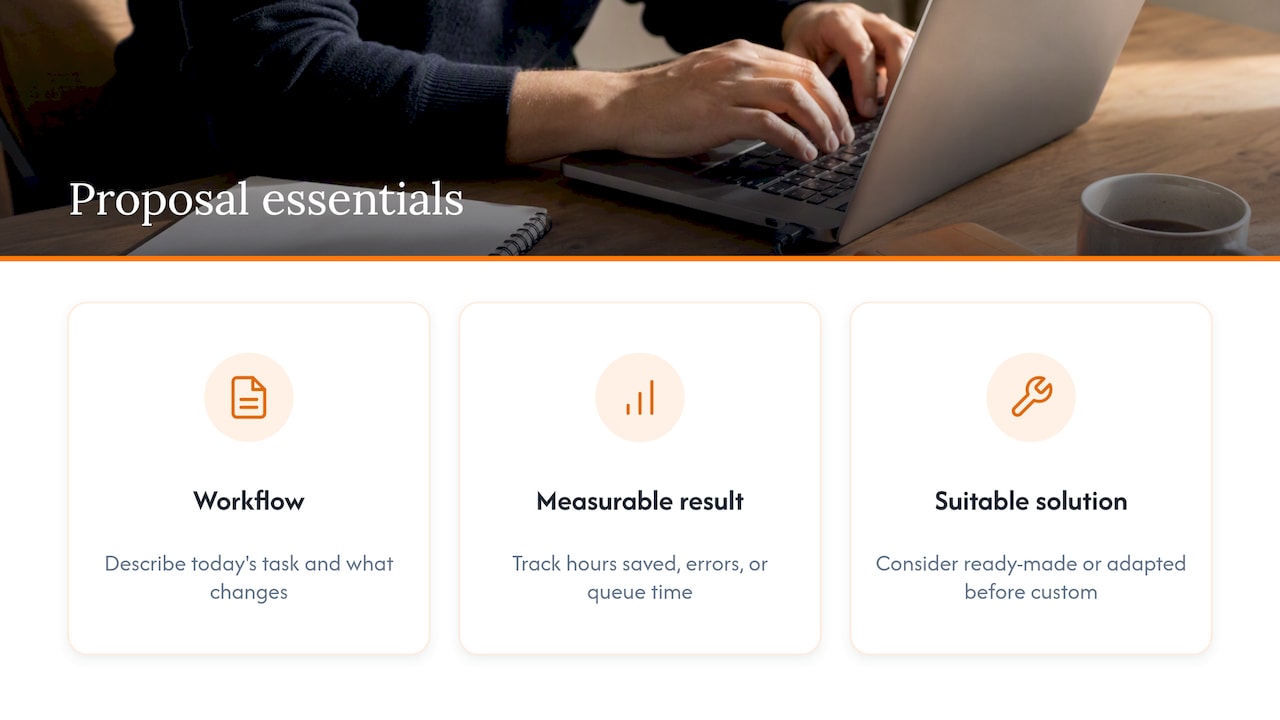
One workflow, clearly described. Say what happens today. For example: “Walk-in customers are registered on paper at the counter, then a staff member types the details into a spreadsheet at the end of the day.” Then say what changes.
A measurable result. Hours saved per week, errors avoided, queue time reduced, orders handled without rework. Use your own numbers and say how you will measure them after launch.
The simplest suitable solution. Cost-conscious does not mean cheap. It means you are not paying for a custom build when a ready-made product, or a product adapted to your process, would do the job. A modest, well-matched project is easier to defend than an ambitious one that nobody can explain.
A realistic scope. A short list of must-have features, a delivery plan and an owner on your side who will test and sign off.
Common software projects SMEs bring
- Point of sale linked to stock and accounting
- Queue and appointment management for customer-facing counters
- Event registration and on-site check-in
- Lead tracking for small sales teams
- Attendance and staffing views
- Internal tools that replace spreadsheets and chat-group approvals
Our notes on piloting one sale first for POS and accounting integration and checking InvoiceNow before choosing inventory software show how we scope this kind of work in small steps.
Our perspective: grants should follow the project
We see the same pattern every year. An owner hears about a grant, looks for a software project to fit it, and ends up with something bigger than the business needs. We think that order is wrong.
Start with the workflow. Find where time is lost. Then ask whether a ready-made product covers it, whether an existing product can be adapted, or whether only a custom build will do. In that order, because each step costs more than the last. Once you know the simplest suitable route and the likely cost, you can see which grant activity, if any, fits it, and whether the application effort is worth it.
Three things we tell owners:
- Do not let the grant choose your software. If support is approved, good. If it is not, you should still want the project.
- Do not start before you are allowed to. A week of waiting is cheaper than losing support on a project you have already paid for.
- Get the scope and cost direction in writing first. You cannot describe a project to a reviewer if you cannot describe it to yourself.
We do not apply for grants on your behalf, and the rules say a third party cannot. What we can do is help you describe the workflow, the options and the likely cost so your own application is clear. Our review is free and confidential, and there is no pressure to commit.
— Ronald
Planning an app project with us
If you want to find the most economical route before you apply for anything, start with our free app fit review. We look at how your team actually works, then recommend a ready-made product, an adapted product or a custom build, and give you early cost direction before any development begins.
- Read how we approach EDG and grant-aware app planning ↗
- See how pricing and scoping work ↗
- Try the product demos ↗
- Or tell us about your workflow through our app development service for SMEs ↗
If your project is bigger and touches accounting, stock and sales together, our page on ERP integration and workflow systems ↗ explains how we approach it.
Choosing a vendor when a grant is involved
When a grant may be involved, vendor selection needs a little more discipline. Ask each vendor the same questions:
- Can you give a fixed scope and a cost direction before I apply?
- Will you wait for my written go-ahead before any work or payment?
- Can you provide documents I will need for a claim: itemised invoices, delivery records, acceptance sign-off?
- Do you understand that I must submit the application myself?
- What happens to my data and files if I do not proceed?
A vendor who is vague on the first two should worry you. For a lightweight way to compare suppliers without a long tender document, see our guide to software vendor selection without RFP bloat.
FAQ
Is the EDG grant still open for software projects?
No. The EDG stopped accepting new applications on 29 September 2026, and new business grant applications now go under the EDGE Grant. Projects already in the EDG pipeline continue to be processed, and claims are submitted through the Business Grants Portal after completion.
Does EDGE pay for custom apps?
EDGE is activity-based, so support depends on which activity your project falls under and what its conditions say. Enterprise Singapore’s pages describe software costs for approved activities such as integrated ERP, with a 12-month cap on software costs. Read the activity page for your exact project, and do not assume a bespoke app is covered until you have checked.
Can my software vendor apply for the grant for me?
No. Enterprise Singapore states that third-party companies cannot apply for or manage the grant on behalf of the applicant. Your own authorised user submits through the BGP with CorpPass. A vendor can help you define the scope and cost, but not submit for you.
Can I start building before I hear back?
No. For EDGE activities, you must not have started work, made payments or placed deposits with any vendor before submitting. Wait until your application is in, and confirm the outcome before you sign or pay anything.
What should I prepare before applying?
Proof of Singapore registration and ownership, a plain description of the workflow problem, a measurable target, a scoped quotation from your vendor and a named person who will manage the project. Having these in hand also shortens the vendor conversation, and a free app fit review is a good place to build them.
Sources
- Enterprise Development Grant (EDG), Enterprise Singapore
- FAQ: Enterprise Development Grant (EDG), Enterprise Singapore
- Integrated Enterprise Resource Planning (ERP), Enterprise Singapore
- Large-scale Digital Transformation, Enterprise Singapore